


Life, Uncooperative, is Still Beautiful
Under an uncanny sky, smoke drifting down from wildfires in Canada, life has carried on around the pond in all its unruly abundance.
The heat has brought on the stinkiest algae bloom, earning me my title of Ungardener once again. Each day I am in pond, net in hand, gathering long strands and cauliflower blooms.
I empty the net on a rock and sift through finding tiny surprises: tadpoles with varying numbers of limbs, and salamander larvae wriggling. All are delighted to return to the water. The bee balm has exploded and is alive with critters, including a hummingbird moth again. A daytime bat circled above me whilst in the pond, swooping low for a drink.
In the small milkweed patch I claimed years ago from incessant mowing, a monarch flits about.
Oh, and I have weeping poison ivy on my face.

Classic Sendak is back on my desk!


Stacks of Anselms


This Incredible Sky


Chaos and Small Victories
The Scout is Out Again!
Meanwhile, on their annual canoeing trip at the Delaware Water Gap, the boys and men of the family fish and chatter. Walter, in setting up his Scout before the storm blew in, dropped it into the river.
A little river baptism!
P.S. I forgot to mention that in Ireland, his pannier popped off over a bump, hurling his Scout into the road where it bounced multiple times. It wasn't built with these particular experiences in mind — but the Scout endures!
SHOP THE SCOUT


A Few Hours Closer to Canada, the Sky is Clear!
Substack and YouTube

Watch on YouTube


Everywhere Astonishments
“If we don’t really, in our time, have an awareness of what we lost then, what is it we’ve lost? – Anthony Metivier in conversation with Rick Rubin
Widow’s Bay Looking forward to Episode 8 tonight:)

@ehaidle mushroom 🍄
The World Refuses to Stay Tidy
Life, Uncooperative, is Still Beautiful Under an uncanny sky, smoke drifting down from wildfires in Canada, life has carried on around the pond in all its unruly abundance. The heat...
Read The Post-


This Summer We Play!
Plein Air Painting as a kind of journaling. Walter has been painting wherever we travel since making the first Scout Box in 2017! I would love to see a wall of the paintings – that would be an incredible installation that would mark our adventures, along with his progress. But he’s given some away to the people we’ve spent time with traveling, and others he’s sold. So we have photographs. So many photographs of so many things.


Walter painted.

When travelling especially, I am reminded of our Smallness.
In the Workshops
Back at home, we are inundated with our own ideas and desires. There is so much to do, and so much to want to do. There has been lots of experimenting this summer:


Søren is working with me and Ashley on videos and helping out with jewelry.


Silas is spending his time in the woodshop with the lathe working through bowl designs from scrap wood.

Walter Putting the stripped old windows with Wobbly Glass back in with brass pulley that open and close like a curtain!

Niko made our New Rogue Tag out of Scrap Leather and Ari is remembering + improving how to make them!

Søren at the Pier with His Rogue
Walter’s Pouches
We’ve made a new batch of Writer’s Pouches from scrap and have used up the rest of our Red Maple and Almond — the last are available now along with our regular colours.

Stationery on the Go! (I wrote SO many letters in Ireland!)
Returning to an Old Project, Alas
I need a project to focus and to widdle away on and have returned to a favourite I put on pause at a few years ago. It still holds up and I must navigate what I don’t know. Little By Little Makes a Lot. Here I go. I'll share progress @beingmargauxkent For now, enjoy a colourful Classic Sendak!

Classic Sendak is back on my desk.

Drawing Family
Substack and YouTube

Everywhere Astonishments
Podcasts enjoyed during our trip:
- Criminal, always a favourite. We listened to this a lot whilst biking.
- Huberman Podcast - Ido Portal I loved this and related so much to moving outside of a formula or ciriculum for a kind of freedom and agililty of the mind and body. I took pages of notes on the airplane.
- Diary of a CEO — Dr. Martin Picard Mitochondria Scientist talks about energy, a subject I am desperate to learn more about.

Colour has come to the once invaded-only hill, but it is still incredibly overwhelming, the rate at which the plants I am ungardening grow. Alas, a view from a stilt-grass-pulling pause.
Ireland Notebooks: In Pigment and Pencil
This Summer We Play! Plein Air Painting as a kind of journaling. Walter has been painting wherever we travel since making the first Scout Box in 2017! I would love...
Read The Post -

Movement and Celebration
We biked and hiked and explored along the coast and up and down the hills and mountains of County Kerry in Western Ireland. I’ve not yet taken it all in, though I’ve taken notes.
I am on Irish time still, not quite ready to be home and navigate the mess I left for myself and we are having a pond party today, so I must jump into the preparation hustle!
Here, a little green from our last two weeks. I look forward to sorting through thoughts and journals and letters and voice memos on a good long walk here in the thick heat of Pennsylvania soon.

Our Mode of Transport

Soggy Great Blasket Island
Our Favourite Recent Reviews
Thank you, always, for your reviews! It is our connection with you and your treasures after we’ve set them free. We love reading through them as they come in daily with personal notes and tales of your adventures. Keep them coming!
Perfection!!!
“I’m in love with this marvelous bag!! It is the perfect size and holds exactly what I need. It is so very comfortable to carry. Thank you Peg & Awl ❤️”
–Christine S.Best carrier I've ever had for my brushes
“I've struggled for years to find the perfect brush carrier for travel and now I've got that and more! The Helga stores all of my brushes for travel and in my studio. I've eyed it since it was first introduced, and finally pulled the trigger and purchased it. Exceeds expectations! I recently enrolled in the Royal Botanical Gardens of Edinburgh Diploma course for Botanical Illustration. I took Helga with me and was so pleased the variety of brushes I could take with me to their recent study week in Edinburgh and for once, I never worried about them getting crushed, misshapen, or compromised in any way! Thank you for creating the penultimate brush carrier! I look forward to its many adventures as I navigate through this program and beyond.” –Stephanie R.
Wyeth Plein Air Box
A wise investment!
“I am not an experienced plein air painter. But this box has made it so easy to just go out and paint. Everything I need in one beautiful, sturdy box. Although it is a bit heavy, I like how it allows me to paint larger. I also primarily paint in watercolor and I haven’t had any issues with the kit. I love how you can arrange the easel at any angle. Moreover, I’m finding that it is completely transforming my practice. I just love it so! The only problem is now I want to bring it everywhere I go. And you do need to invest in a high quality travel tripod so between the box and the tripod it is definitely an investment. But one I’m finding is totally worth it.” –Akane Z.It’s my new hobby
“This bookbinding kits was absolutely brilliant!! Project was ready to go right from the package with amazingly clear instructions. I literally had a new book in my hands in about 20 minutes!! I added an old postcard (cut down to size) for the front and back cover to jazz it up a bit. Loved that you could still see the stitching once the book was complete. Lays flat and perfect for anything you want to do with it—sketch, journal, photos etc!! Highly recommended and would buy more from this great company!” –Catherine J.The joy of walking
“I have always been a walker. I have found joy, solace and the bonus of fitness from walking. I am thrilled to have found this beautiful ring as a symbol of that pleasure.” –Christine M.
Classic Sendak Artist Roll
The best gift I ever gave myself was my Sendak Artist Roll
“I have been an artist all my life and was a traveling artist for over two decades. I taught classes at retreats, art stores, and conventions. I spent years trying every type of organizational products for my art supplies. Some worked better than others, but none were the perfect answer for my organizational needs. I needed my supplies to stay in place and be easily accessible as I was teaching. When I saw the Sendak I thought it looked promising and I ordered one that day. My Sendak met all my needs and expectations. I love that my supplies stay where they are put and so easily at hand. Also I no longer waste time checking that my treasured tools are safe. It saves my time from digging for what I need and confidence in knowing it is easily at hand.” –Rebecca K.
I had a great conversation with Miss mustard seed. Read here!
Substack + YouTube
Everywhere Astonishments
Ashley, my sister-in-law and partner in newsletters and videos and more here at Peg and Awl, has moved to an old farm with her family. I love seeing it come to life!

Happy Chickens!
☘️ Ireland Journal Fragments
Movement and Celebration We biked and hiked and explored along the coast and up and down the hills and mountains of County Kerry in Western Ireland. I’ve not yet taken...
Read The Post


Product Care and Tutorials
-
-

-
One of the key steps to speed up the breaking in process of leather is to simply twist and roll the leather in your fingers. As you use your bag the leather will naturally soften and become much easier to maneuver. Whether you help it out, or simply use your bag, the breaking in process does not take long!!
*What is Vegetable Tanned Leather? Vegetable tanning is a slow, natural, and sustainable process of tanning raw hides with natural, biodegradable extracts derived entirely from vegetable sources such as tree bark.
Our bags are made with full-grain vegetable-tanned leather*, which is a durable leather that develops a lovely patina over time with continued use. It is thicker than conventional, chrome-tanned leather, which also lends it to be more stiff in the beginning. This video shows how to quickly soften the leather, as well as the proper steps for detaching and attaching the leather shoulder strap and front closure on our Peg and Awl bags.
One of the key steps to speed up the breaking in process of leather is to simply twist and roll the leather in your fingers. As you use your bag the leather will naturally soften and become much easier to maneuver. Whether you help it out, or simply use your bag, the breaking in process does not take long!!
*What is Vegetable Tanned Leather? Vegetable tanning is a slow, natural, and sustainable process of tanning raw hides with natural, biodegradable extracts derived entirely from vegetable sources such as tree bark.
Step 1: Detaching the Strap
*The leather is the most stiff when it is new. As you use it and work with it, it will soften.- Hold the button stud and pull the leather strap to bring the button stud into the leather slot.
- Firmly and slowly work the leather over the button stud. Take your time working with the leather as it softens.
Step 2: Attaching the Shoulder Strap-
Twist and roll the strap to soften the leather. It does not take long to break in.
-
Press the leather slot over the button stud. Hold the stud and pull the leather strap to bring the stud into the hole.
Our Leather!
Our first bag – The Waxed Canvas Tote – which we finished with reclaimed military leather slings found at a flea market. Dusty and dull with years of neglect, the leather was unassuming. But with some hot soapy water, perseverance, and beeswax balm, we removed the layers to find stories told through the markings of days past. We were delighted! The usefulness of the leather sent us on a mission to scour flea markets and military shows for as many old slings as we could find. For years we used these relics to finish our bags – until there were no more to be found.
And so, a new mission was soon underway: the search for the right new leather. We began in the UK driving along long and winding roads through the English countryside to visit J&FJ Baker, a 500-year-old tannery. This experience and many subsequent conversations enriched our understanding of a leather world we had known nothing about.
While shipping leather from the UK turned out to be impractical, we left enlightened with the knowledge that there do exist a few companies who produce leather in a sustainable and responsible way. When we returned to America we found Wickett & Craig – only a stone’s throw from our shop in Philadelphia. Their vegetable tanning process is a slow, natural, and eco-friendly process of tanning raw hides with natural, biodegradable extracts derived entirely from vegetable sources such as tree bark. This durable leather breaks in and gathers a gorgeous patina, bearing the marks of the users’ (and makers’) adventures – the very thing we’ve always celebrated! We’ve been using this leather for three years now and love it!
With the transition from using reclaimed WWII era gun straps for our leather handles to using locally-sourced vegetable-tanned leather, we are reaffirming the fellowship between ourselves and the materials with which we make. By creating beautiful and useful objects out of sustainable and responsibly sourced materials, we strive to change the way that we as individuals make, use, repair and reuse everyday objects. As our new bags leave our Philadelphia workshop and arrive at your doorsteps, what adventures will they see in your hands and how will they transform to become truly yours?


Vegetable tanned leather is made with a slow, natural, and sustainable process of tanning raw hides with natural, biodegradable extracts derived entirely from vegetable sources such as tree bark. The more you use your bags and journals, the softer the leather will become. 

This durable leather breaks in and gathers a gorgeous patina, bearing the marks of the users’ (and makers’) adventures! Here, you can see the leather on Walter's Tote and Scout. As you use your bag the leather will naturally soften and become much easier to maneuver. 

We took out Hunter's out on an Amethyst dig! they got pretty dirty, so we turned the bags inside out, tapped out the dirt and wiped the inside with a sponge and put them in the sun to dry. Our Finch is my favourite bag - I carry mine nearly everyday. It holds my books, journal, water bottle, and other bits comfortably. Adjusting the Leather Straps on our Waxed Canvas Bags
One of the key steps to speed up the breaking in process of leather is to simply twist and roll the leather in your fingers. As you use your bag...
Read The Post


One of the key steps to speed up the breaking in process of leather is to simply twist and roll the leather in your fingers. As you use your bag the leather will naturally soften and become much easier to maneuver. Whether you help it out, or simply use your bag, the breaking in process does not take long!!
*What is Vegetable Tanned Leather? Vegetable tanning is a slow, natural, and sustainable process of tanning raw hides with natural, biodegradable extracts derived entirely from vegetable sources such as tree bark.
Our bags are made with full-grain vegetable-tanned leather*, which is a durable leather that develops a lovely patina over time with continued use. It is thicker than conventional, chrome-tanned leather, which also lends it to be more stiff in the beginning. This video shows how to quickly soften the leather, as well as the proper steps for detaching and attaching the leather shoulder strap and front closure on our Peg and Awl bags.
One of the key steps to speed up the breaking in process of leather is to simply twist and roll the leather in your fingers. As you use your bag the leather will naturally soften and become much easier to maneuver. Whether you help it out, or simply use your bag, the breaking in process does not take long!!
*What is Vegetable Tanned Leather? Vegetable tanning is a slow, natural, and sustainable process of tanning raw hides with natural, biodegradable extracts derived entirely from vegetable sources such as tree bark.
*The leather is the most stiff when it is new. As you use it and work with it, it will soften.
- Hold the button stud and pull the leather strap to bring the button stud into the leather slot.
- Firmly and slowly work the leather over the button stud. Take your time working with the leather as it softens.
Step 2: Attaching the Shoulder Strap
-
Twist and roll the strap to soften the leather. It does not take long to break in.
-
Press the leather slot over the button stud. Hold the stud and pull the leather strap to bring the stud into the hole.
Our Leather!
Our first bag – The Waxed Canvas Tote – which we finished with reclaimed military leather slings found at a flea market. Dusty and dull with years of neglect, the leather was unassuming. But with some hot soapy water, perseverance, and beeswax balm, we removed the layers to find stories told through the markings of days past. We were delighted! The usefulness of the leather sent us on a mission to scour flea markets and military shows for as many old slings as we could find. For years we used these relics to finish our bags – until there were no more to be found.
And so, a new mission was soon underway: the search for the right new leather. We began in the UK driving along long and winding roads through the English countryside to visit J&FJ Baker, a 500-year-old tannery. This experience and many subsequent conversations enriched our understanding of a leather world we had known nothing about.
While shipping leather from the UK turned out to be impractical, we left enlightened with the knowledge that there do exist a few companies who produce leather in a sustainable and responsible way. When we returned to America we found Wickett & Craig – only a stone’s throw from our shop in Philadelphia. Their vegetable tanning process is a slow, natural, and eco-friendly process of tanning raw hides with natural, biodegradable extracts derived entirely from vegetable sources such as tree bark. This durable leather breaks in and gathers a gorgeous patina, bearing the marks of the users’ (and makers’) adventures – the very thing we’ve always celebrated! We’ve been using this leather for three years now and love it!
With the transition from using reclaimed WWII era gun straps for our leather handles to using locally-sourced vegetable-tanned leather, we are reaffirming the fellowship between ourselves and the materials with which we make. By creating beautiful and useful objects out of sustainable and responsibly sourced materials, we strive to change the way that we as individuals make, use, repair and reuse everyday objects. As our new bags leave our Philadelphia workshop and arrive at your doorsteps, what adventures will they see in your hands and how will they transform to become truly yours?
|
|
|
|
|
|
Adjusting the Leather Straps on our Waxed Canvas Bags
One of the key steps to speed up the breaking in process of leather is to simply twist and roll the leather in your fingers. As you use your bag...
Read The Post-

Visiting Family in Northern Ireland!
I filled magical few days of unexpected Irish sun and unexpected Irish sunburns. Good food, good conversation, an exploration of vintage film cameras, and so many ways to enjoy a lake!

Backyard football!

TSA asked why my bag was so heavy 😫 hobbies and glass containers?! And the other one? Food and tinned fish 🐟 help me.

Titus took to the cameras!

Four Boys in a Boat
In Dublin
We crammed a lot into less than 24 hours. We visited Oscar Wilde’s house (which is in dire need of material), saw a William Blake exhibit, ate good food, walked, and saw Mick Flannery whom I’d return to Ireland to see again, so so good was the show
SHOP STUDIO COLLECTION
Watch our tutorial on making my journal!

Leaving Oscar Wilde’s House

Mick Flannery with The House Must Win Band and incredible vocalists

Breakfast at Tang
Train to Tralee
We are in Dingle today as I write. The cool breeze is coming through a crack in the window, warm coffee and the sound of dishes through my headphones. May break from the heat, the pendulum swings. Today begins our six-day bike ride.

Past Of a Kind pouch full of necessities.

Bags, bags, bags we no longer make.

Cards from the Mick Flannery show

And we’re off!
Substack + YouTube
I didn’t manage to transfer my journaling to Substack yet, having only a phone I’ve pushed it off. I’ll catch up, I’m sure of it!
Everywhere Astonishments
It’s all been astonishing! Also, reading Land by Maggie O’Farrell. The book is filling the front window of every bookshop here!

Storefront
The Peg and Awl Storefront is open for visitors! Come see our treasures in person along with other maker’s treasures and vintage finds.
Monday–Friday 10–5
OUR STOREFRONT
Ireland, In Fragments
Visiting Family in Northern Ireland! I filled magical few days of unexpected Irish sun and unexpected Irish sunburns. Good food, good conversation, an exploration of vintage film cameras, and so...
Read The Post -

We at Peg and Awl, lovers of newness and change, keep going back to the past for a new, new old. Life is mysterious this way.
This collection contains faded quilts, old tools, tins, the feeling of a hot summer porch a hundred years ago, paired with military bits from local soldiers. It’s not the past itself we are longing for it is the overlap of time. And it consumes us.
Bookbinding Pouches!
This is our first filled pouch containing relics of the past – refreshed – alongside our objects, new and classic! We love incorporating old stuff with the new, both found and made. This includes a sweetie pouch made from an old, very well-worn quilt, which I imagine on hot-summer-porch sleepovers atop the family that constructed it and maybe traded some scrap with the neighbours for the variety of colour and patterns it contains.
Eleven new and vintage treasures, cozily contained.
Each pouch and its contents are their own Dusty Summer colour story.- 4" Anselm Bookbinding Kit
- 4" Book Template
- Bartram Cherry Ruler
- Dusty Summer Scrap Bundle
- Vintage School Scissors
- Antique Awl
- Vintage Floss
- JM Paillard Gouache
- Art Graf Pencil
- MT Washi Tape
- Coccoina Glue Stick

Each pouch and its contents are their own Dusty Summer colour story.
Sendaks, Bags and Pouches

US Mint Sendak Nutshell

Spender Pouch with US Mint Bag Scraps!
Tinned Sketchbooks + Other Art Supplies
Here we are with more clean-cut watercolour sheets tucked into vintage tins for your petite paintings along with some other new arrivals.

Treasures straight from the flea market
Graphite Drawing Bundle offering inspired by inquiries from our Dream Journal Video Tutorial!
Collections Explained
If you’ve been following along with us for a while, you may have noticed that not all launches are the same – some products stay for years, some fly off the shelves, and others fall somewhere in between. Here are some explanations to distinguish between our various collection types.
Standard Collections: Everything in our standard collections will be ongoing until we decide to stop making them! They may include some vintage or antique materials, (ex. journal fabric lining) but these details will vary subtly to ensure their ongoingness.
Small Batch Collections: Limited batches incorporating vintage or antique materials where larger batches can be made, but are not infinite! The quantity ranges, but we aim for minimum of 100 in these collections.
Of a Kind Collections: Limited batches incorporating vintage or antique materials. Each object will be limited from 1–20 items depending upon our findings.
Substack + YouTube
Storefront
The Peg and Awl Storefront is open for visitors! Come see our treasures in person along with other maker’s treasures and vintage finds.
Monday–Friday 10–5
NEW Dusty Summer Of a Kind Collection
We at Peg and Awl, lovers of newness and change, keep going back to the past for a new, new old. Life is mysterious this way. This collection contains faded...
Read The Post


Press
-

-

Press: Cultivating Place Podcast
Cultivating Place: Natural History & Our Gardens The Adventurous Art of Cultivating Place, with Peg & Awl
Read The Post -

Press: Leslie Stroz
Scout Plein Air Box Review The Sendak Artist Roll Review More Leslie Stroz Videos Featuring Peg and Awl! Rating ALL of My Travel Watercolor PALETTES (the BEST and WORST) BEST...
Read The Post


Press: Cultivating Place Podcast
Cultivating Place: Natural History & Our Gardens The Adventurous Art of Cultivating Place, with Peg & Awl
Read The Post
Press: Leslie Stroz
Scout Plein Air Box Review The Sendak Artist Roll Review More Leslie Stroz Videos Featuring Peg and Awl! Rating ALL of My Travel Watercolor PALETTES (the BEST and WORST) BEST...
Read The Post-

-

The Sendak Artist Roll: A Walkthrough Video
We’ve watched all of the YouTube reviews of our Sendak Artist Roll (thank you!) and have made our own video to answer some questions and share our experience! We are...
Read The Post


Bookbinding Tutorials
We have put together a long overdue tutorial on bookmaking. I have prepared a list of things you will need to make your first notebook. This is a very simple start—you can use materials that you have at home and anyone, any age can join in!
So, let’s make books!
-
Explore Our Tutorial Series to Bind Your Own Journal. You can use materials that you have at home, and anyone of any age can join in!
Photo by @holddear
Share your Peg and Awl with #quarantinebookbindingclub to be featured!


Bookbinding Tutorials
Read The Post -
So here we are again – still at home and pleased to share our next installment of our Bookbinding at Home series! We hope you have found some small things to enjoy in this time of truly slooooowing down. For me it is always the small things that brighten my days, like watching Toots and Yedda – our goose landmates – and transforming a pile of field stone into an elegant yet makeshift garden path!
As for the tutorials, we are learning a lot (we hope you are too) and are so grateful for everyone who is joining us!
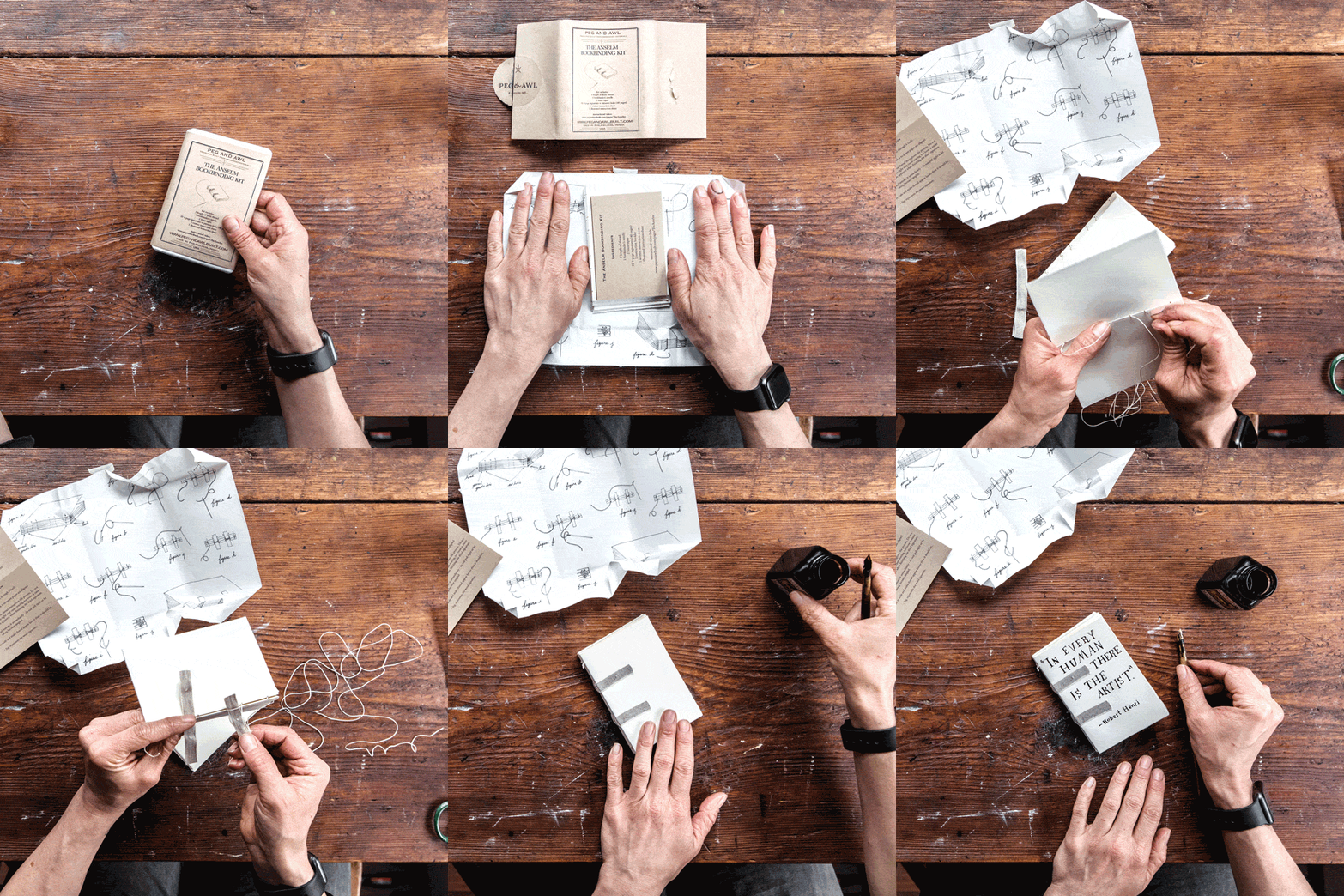
Bookbinding at Home: Part 2
So here we are again – still at home and pleased to share our next installment of our Bookbinding at Home series! We hope you have found some small things to enjoy in this time of truly slooooowing down. For me it is always the small things that brighten my days, like watching Toots and Yedda – our goose landmates – and transforming a pile of field stone into an elegant yet makeshift garden path!
As for the tutorials, we are learning a lot (we hope you are too) and are so grateful for everyone who is joining us!
Project No. 2: Stitching Signatures for a Coverless Sketchbook


Here is what you will need:
1. Needle – bookbinding needles have roundy tips and big eyes, but most needles will work!
2. Thread – any thread will do. If it is super thin, double it up.
3. Pencil – grab your favourite pencil to plot your stitching holes.
4. Paper – this is for the inside. Do you like lined paper, sketch paper, the back of used paper, graph paper? Gather your favourites, mix ’em up or stick to one!
5. Thumbtack – or something sharp to poke holes through paper and cardstock.
6. Scissors – for snipping your thread.
7. Fabric – this will serve as your linens that will hold the book together. Happy treasure hunting!
8. Glue – to glue your fabric to the front and back covers of your book. Elmers works!
We get most of our bookbinding tools and materials from Talas, including needles, thread, linen tape and other materials we haven’t explained yet. The waxed thread that I am using is a 3 ply waxed Irish Linen thread.
We love Strathmore drawing paper for our journals and find that and other supplies through Artist & Craftsman. Both the latter and Talas are small companies who have shut down their physical locations but are currently taking online orders and shipping!
As for covers, vintage textiles, needle boxes and vintage tools – you can find all kinds of unexpected magic at home as well as on Etsy and eBay. We at Peg and Awl absolutely encourage creativity in materials and tools, and finding vintage stuff is a nice way to reclaim some of the excess of items that already exist on our planet. This is also a way to make your project and your desk specifically yours!
Bookbinding Glossary
Sheet: The unfolded paper pages that you start your project with
Folio: A folded sheet
Signature: Gathering of folios
Leaf: One half of a folded sheet
Page: Each side of each leafPlease share your little books with us with hashtag #quarantinebookbindingclub – we’d love to see what you are making, and share the results!
The Next Step…
Continue on with our next bookbinding project: covering a coverless book! We will only be covering a book, so bring your coverless book from this project to the next installment.
And While You’re at Home…
If you are housebound or feeling antsy, there are oodles of projects online and on Instagram. I’ve found inspiration from The Good Ship Illustration’s drawing guide The Sketchbooker’s Friend. The first tip is pretty great:
NO PHONES. Don’t take a photo, then draw from it. Don’t finish your drawing at your desk later. It is NOT ALLOWED and we are very strict!
Bookbinding at Home, Part 2: How to Stitch a Coverless Journal!
Read The Post -
Here is the last video in our first bookbinding tutorial series: Bookbinding at Home. Thank you all for following along and sharing your books. We are so psyched to see all of the books that have come out of these tutorials!
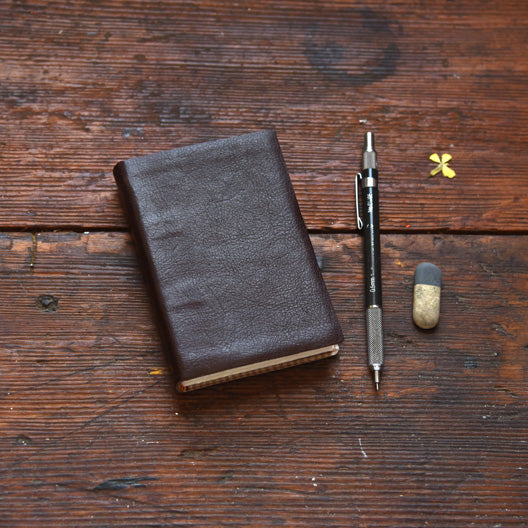

Here is the last video in our first bookbinding tutorial series: Bookbinding at Home. Thank you all for following along and sharing your books. We are so psyched to see all of the books that have come out of these tutorials! We hope you find comfort in the process of binding your books as well as filling them. There is certainly a lot to document right now— in both pictures and words.
We love seeing your books and sharing in our Instagram stories and posts (@pegandawl) – be sure to use #quarantinebookbindingclub and/or #pegandawlbinds on your social media posts so we can find you!Project No. 3: Covering a Journal with Leather
Here is what you will need:
Leather – If you have scrap, an old jacket or wallet, anything soft and malleable, have it ready! Scraps of many colors are also available from many sellers on Etsy.
Fabric – This will replace mull (a starched cheesecloth) that will be glued directly to your book block to strengthen your book.
Thread – For the headband. Aim for something thick that will take up space. You can also use a pre-made headband.
Scissors – For trimming your cover. If you are using leather for your cover, make sure they are sharp!
Hammer – For shaping your book block. Be sure it is clean as it will be coming in contact with your paper! (I used a rock hammer and my pages don't hide it!)
Glue – For gluing your leather to the front and back covers of your book. Elmers works!
Heavy Book – This will be your book press! Any heavy book will do, though I find art books (and their dense pages) perfect for the job!Bookbinding at Home Part 3: Covering a Journal with Leather
Read The Post -
We’ve made another video installment to our Bookbinding Tutorials – this one is in response to all of the detailed questions you’ve been asking about our materials. I’ve also shared a little of my bookbinding history—where you can see my old falling apart journals as well as some insides and a variety of antique leather outsides!
We’ve made another video installment to our Bookbinding Tutorials – this one is in response to all of the detailed questions you’ve been asking about our materials. I’ve also shared a little of my bookbinding history—where you can see my old falling apart journals as well as some insides and a variety of antique leather outsides!
Chapters:
0:00 List of Materials
0:32 How Margaux Got Started Bookbinding
1:37 Margaux’s Early Journals
2:59 Overview of Materials
3:31 Thread
4:07 Needle
4:38 Tape
5:14 Headband
5:38 Mull
5:49 Glue
6:03 Cover
8:32 Paper
9:07 ConclusionBookbinding at Home Part 4: Materials and Meanderings
Read The Post
-

“. . . Practice any art, music, singing, dancing, acting, drawing, painting, sculpting, poetry, fiction, essays, reportage, no matter how well or badly, not to get money and fame, but to experience becoming, to find out what’s inside you, to make your soul grow.”
–Kurt VonnegutA filthy treasure this one! Not happy unless he is fully submerged in his work. Here he is torching garden boxes in 80 degree weather to finish in time for Søren’s graduation party. May we all spend our days so immersed.

A Day in NYC

In Italy.
Søren Graduated!
Ah, all of life is bittersweet. The daily loops are easy to lose a thread in, and these monumental events are the shaking I need. Søren’s graduation was intimate and particular – a tearful extravaganza! Now we are settling into the nooks and crannies of our last chaotic summer together.

Art Days with Søren

Graduation Speech – so funny, well-written, presented, so, so good.

Our visit to SCAD, there will be many more!
Claire Rosen Show ft. Goats
We had an incredible experience back in our old neighborhood of Fishtown, which led to some melancholy for both me and Walter, but maybe a push we need! Claire filled the Ice Box at InLiquid with stunning portraits of goats. Memories of baby Søren beneath my table of handmade journals welled up — that space holds a lot. The Philly Goat Project filled the room with actual goats, who wandered around the exhibit being fed from a table spread filled with their favourite garden treats!

Claire at the End of a Long Day Setting Up

At the End, the Goats FEASTED!

The Aftermath
Of a Kinds Peek – Launch Date and Time
Our next Of a Kind Collection is coming together and may the biggest and most magical yet! We will send the newsletter out at 10ish on June 20th, 2026.

Pearly in the middle

Bookbinding Pouch

Flea Market Finds, Washed an Drying
Substack + YouTube
We’ve been sharing journal-making processes since the pandemic started on our YouTube channel a bit willy-nilly. It’s been fun and we are working more diligently and slightly more strategically to share more. Our channel is creeping toward 9,000 subscribers! The last video included a peek inside my journals and elicited lots of responses, so we will share more innards.
Everywhere Astonishments
Podcast: Hidden Brain.
Book: The Art Thief continued
Movies: Backrooms, La ChimeraReminder. I always forget to remember.
Keep track of what you've done, not just what you have not done.The Art Thief has been a fun world to (re)enter. I am remembering Freakonimcs three part series on The Hidden World of Art, Season 11, Episodes 20, 21, and 22. I am also tempted to reread Donna Tartt’s epic novel, The Goldfinch.
Storefront
The Peg and Awl Storefront is open for visitors! Come see our treasures in person along with other maker’s treasures and vintage finds.
Monday–Friday 10–5
Happy Early Father’s Day!
“. . . Practice any art, music, singing, dancing, acting, drawing, painting, sculpting, poetry, fiction, essays, reportage, no matter how well or badly, not to get money and fame, but...
Read The Post -

I love the Finch Satchel. The familiarity of its shape against my body, holding what I need for the day. It is a good size, but I will always jam it – things rising out over the edge, the weight of it. Over the years we’ve been Smallening everything. We have a Mini Tote, a Small Hunter, two smaller Sendaks — and now, alas, a Small Finch. The comfort of the Finch, with the nudge to carry less.

Coal, Spice, Moss, Truffle, Slate, All Black

Classic Finch and New Small Finch!
Impromptu Bookbinding Workshop + One in the Works!
I was so lucky to have spent a day with these five – Andrea Bruce, Claire Rosen, Maggie Steber, Adriana Zehbrauskas, Kirsten Luce – just scratching the surface of stories. Claire, who has known them for years and taught photography alongside them around the world, brought them to the Five Acre Wood for a bookbinding and paint making workshop.
Photographs by Claire Rosen

Sitting on the floor around our Kino Coffee Table to work!

Sewing Details
Making Little Things
I’ve been making little things for little things.

Another Small Brush

We love Customer Photographs
Thank you always for your generous feedback! We love reading, seeing, and sharing it. (And my parents love reading it too — the sweetest!)
Photographs by Suzanne N.
Family Stuff
My view through the screen during our meetings. Still zooming.

Ashley and Eden

Gilbert and his Desk Caddy

Sub 5 Mile!

Eden Fishing
Substack + YouTube
Everywhere Astonishments
Music: New Mick Flannery and Aldous Harding. Re-obsessing with an old favourite likely responsible for some the ringing in my ears from so many right-in-front-of-the-speaker nights: PJ Harvey. Prayer at the Gate, is perfect during my wild wavy weather wanderings!
Podcast: The Nature Of Podcast with Suzanne Simard
I was walking in the woods last night with Pearl, slurping honeysuckle and enjoying the cool night when Walter sent a song suggestion: Spitting of the Edge of the Earth by The Yeah Yeah Yeahs with Perfume Genius! It struck all the right chords and I danced with Pearl on the path as the sun set. A reminder to share things we love!


Storefront
The Peg and Awl Storefront is open for visitors! Come see our treasures in person along with other maker’s treasures and vintage finds.
Monday–Friday 10–5

The Littling: New Small Finch
I love the Finch Satchel. The familiarity of its shape against my body, holding what I need for the day. It is a good size, but I will always jam...
Read The Post


